


You’re reading this from Miracle Body and Paint Collision Center, your San Antonio collision specialist. In 2025, the collision market faces harder estimates and fuller shops as diagnostics, parts, and labor costs climb. You’ll see how rising inflation and complex vehicle systems change your service timeline and quote.
Modern vehicles need more upfront scans and calibrations to protect safety systems. That means shops spend extra time on diagnostics and supplements before they start visible work.
You’ll also learn why EVs and lightweight materials shift planning, tools, and limits on what can be fixed. Shops that use AI, automation, and strong data tools improve estimate accuracy and communication for you.
By the end, you’ll know how inflation, parts availability, and technician supply shape your experience — and how to choose a trusted business partner in San Antonio to handle your collision needs.
Key Takeaways
- Vehicle technology raises upfront diagnostic work to keep safety systems functional.
- Inflation and parts costs affect estimates and scheduling even at efficient shops.
- EVs and modern materials require new tools and repair plans.
- AI and data help improve estimate accuracy and cycle time.
- Choose local, experienced shops like Miracle Body and Paint Collision Center for complex collision work.
San Antonio’s Collision Landscape: Market Pressures Shaping Your Repair Decisions
Local market forces in San Antonio are reshaping estimates, timelines, and how shops prioritize work. Inflation, parts scarcity, and fewer technicians mean your quote can change before work begins. Miracle Body and Paint Collision Center serves you locally, so you get clear estimates and timely updates from a San Antonio team that knows neighborhood roads and insurers.
Rising repair costs, inflation, and what that means for your estimate
Inflation peaked at 9.1% in June 2022 and still pressures parts and labor. Expect estimates to reflect recent repair costs for parts, paint materials, and sublet services across San Antonio.
Technician shortages and cycle times: how shops are adapting
The number of collision technicians fell from 158,600 in 2017 to 152,500 in 2021. That decline creates capacity challenges and can extend times for certain jobs.
- Many shops use data-backed scheduling to speed triage and prioritize safety and drivability first.
- Precise estimating up front—scans, planning, and coordination—reduces supplements and speeds overall collision work.
- Your local repair shops can escalate sourcing or approvals quickly when the market tightens, helping control costs and delays.
Auto Body Repair Trends Driving 2025 and Beyond
Modern vehicles demand early diagnostics to prevent surprises after teardown. Shops now include scans and test drives on day one so hidden faults show up in the estimate. That reduces late supplements and keeps your schedule clearer.
Vehicle complexity, scans, and calibrations
Scans are no longer optional. As of Q3 2024, about 83% of scans are on the initial estimate, while over 60% of calibrations arrive as supplements after disassembly.
That rise means parts, ADAS modules, and glass with embedded tech change the economics of a fix. Miracle Body and Paint Collision Center integrates OEM procedures and local insurer workflows so you get accurate planning on complex vehicles in San Antonio.

Risky driving and sustained demand
Risky behaviors keep collision volumes high. In 2023, more than 65% of drivers admitted dangerous actions and roughly 30% drove distracted.
That reality sustains demand and affects shops’ capacity and cycle times.
Pricing shifts and the repair vs. replace choice
New-vehicle prices climbed from $36,555 in 2019 to $48,623 in Oct 2024. Higher financing rates make vehicle replacement harder for many owners.
So you’ll often see a careful evaluation of damage, parts, and labor costs before a total loss decision is reached.
- You’ll see why structured diagnostics on day one protect you from surprise supplements.
- Accurate photos and documentation speed approvals for high-tech vehicle repair.
- Shops use data to order parts earlier and shield your timeline from delays.
ADAS and Safety Systems: Calibration, Procedures, and Quality Control
When sensors or mounting points shift, precise OEM calibration becomes a safety necessity. You should expect shops to treat sensors and modules as safety features, not optional extras.
Why precise OEM-calibrated work protects safety systems
OEM procedures set tolerances, target positions, and environmental conditions that restore pre-loss performance. By Q3 2024, nearly 83% of scans were on initial estimates and over 60% of calibrations arrived later as supplements. That data shows why early scans and documented calibrations matter.
Workflow changes: integrating diagnostics into the initial estimate
Shops now add pre- and post-scans, road tests, and quality gates into the first plan. This limits surprise supplements and keeps your timeline steady.
- You’ll learn why alignment, radar and camera calibration, and steering-angle resets are essential to full safety system restoration.
- Specialized tools, level floors, targets, and software subscriptions are mandatory for valid calibrations.
- Trained technicians document DTCs, calibration certificates, and final validations for you and your insurer.
At Miracle Body and Paint Collision Center, you get OEM-informed procedures, calibrated results, and clear quality checks so your family stays protected after a collision repair.
EVs and New Materials: Specialized Skills, Tools, and Safety Protocols
Electric vehicles and new structural materials demand new safety steps, dedicated workspaces, and updated technician skills. Miracle Body and Paint Collision Center follows strict high‑voltage safety protocols and uses dedicated aluminum areas to protect you and your vehicle.
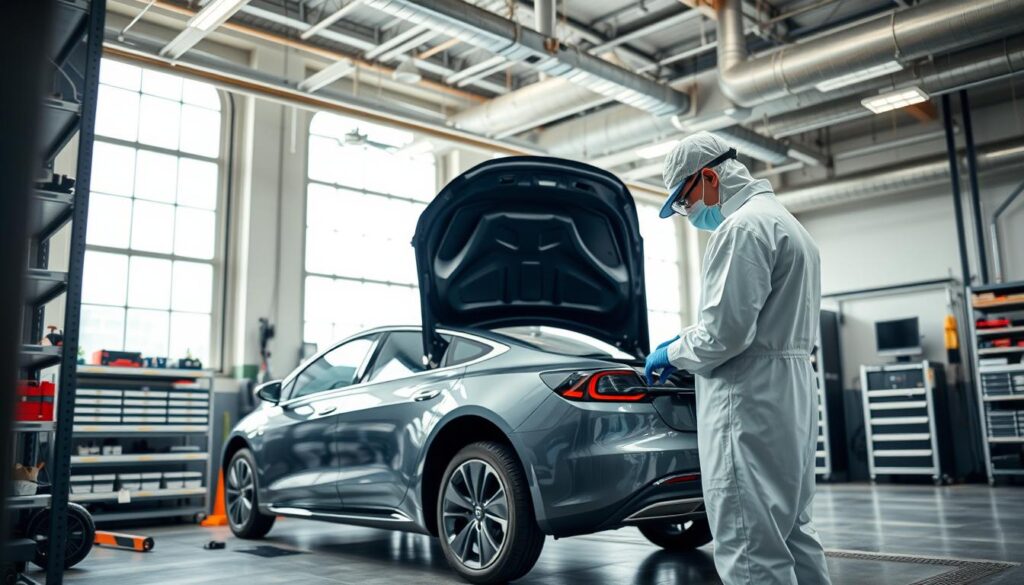
High‑voltage work requires isolation, OEM battery handling, and non‑conductive tooling. Technicians use insulated tools, PPE, lockout/tagout, and thermal monitoring to protect battery integrity during repairs.
Aluminum and carbon fiber need separate tool sets, clean areas, and special welding or bonding. Some carbon fiber parts have limited repairability and must be replaced per OEM procedures.
- You’ll see how disable/enable steps, insulation checks, and thermal monitoring protect batteries.
- You’ll learn why separate tools and clean rooms prevent contamination on aluminum jobs.
- You’ll discover when carbon fiber is repairable and when replacement is required.
3D printing shortens lead times for non‑structural brackets and templates, while AR/VR training keeps crews current on new joining technologies and OEM limits. Shops communicate timelines, parts lead times, and post‑repair system checks so customers know what to expect.
AI, Automation, and Data Analytics in Modern Collision Repair Shops
Modern technology transforms how your repair moves from estimate to delivery. Miracle Body and Paint Collision Center leverages digital estimating, photo AI, and connected communications to keep you informed and your repair moving.
AI-powered damage assessment for faster, more accurate planning
Photo AI scans submitted images and flags likely structural and ADAS risk areas before teardown. That helps estimators build more accurate blueprints and cuts surprise supplements.
Automation that streamlines parts, labor, and insurance communications
Connected tools sync parts status, supplement requests, and insurer messages. Automation reduces idle time by routing orders and approvals quickly, improving efficiency across the shop.
Data-driven decisions: reducing cycle times and improving repair quality
Data analytics prioritize tasks that shorten delays and cut rework. Dashboards show repair stage progress and expected delivery times so you know what to expect.
- Photo triage spots hidden indicators before disassembly.
- Inventory automation keeps parts flowing to minimize downtime.
- Integrated platforms streamline labor routing and documentation.
- Estimators use AI insights to raise accuracy and outcomes.
You’ll benefit from systems validation built into the workflow so quality checks are not an afterthought. These solutions help repair shops deliver safer, faster vehicle repair with clearer communication for you.
Sustainable Body Shop Practices Without Compromising Results
Sustainability no longer forces trade-offs between eco goals and high-quality finishes. At Miracle Body and Paint Collision Center, you get waterborne paint systems, waste-reduction practices, and energy-wise processes that protect finish quality and warranty standards.
Water-based coatings cut VOC emissions while delivering OEM-grade color match and durability. Shops that adopt these systems also use calibrated mixing and digital color tools to keep results consistent.
Energy-efficient booths and smart curing reduce cycle time and stabilize finish quality through seasonal changes. These technologies lower operating costs and improve efficiency for your vehicle.
- You’ll understand how water-based paints cut emissions while delivering OEM-grade finishes and color accuracy.
- You’ll see how energy-efficient booths and smart curing save time and stabilize quality across seasons.
- You’ll learn how smarter materials use and recycling reduce waste without sacrificing repair integrity.
- You’ll discover how sustainability programs align with disciplined process control that benefits your vehicle and wallet.
- You’ll appreciate how transparent communication around products and processes builds trust with customers.
Certification programs in the repair industry reward shops that track material use, manage supply carefully, and document process controls. Those standards often mean fewer surprises, better timelines, and clearer costs for you.
Supply Chain Challenges and Technology Solutions in San Antonio
Global disruptions and local risks have made parts sourcing a daily task for shops in San Antonio.
Labor shortages, strikes, and events like the Key Bridge collapse show how a single route failure can reroute freight and delay your repair times.
Parts availability, tariffs, and rerouting risks—and how shops mitigate delays
Miracle Body and Paint Collision Center actively tracks parts ETAs and shares options so you can choose OEM, aftermarket, or remanufactured parts quickly.
Early sourcing and pre-authorized alternates reduce backorders and cut the chance of surprise supplements later.
Connected supply chains: tracking, forecasting, and OEM procedure compliance
Connected systems give real-time status on allocations and expected ship dates.
These solutions let shops forecast high-risk components, document OEM procedure compliance, and keep insurers confident in the scope and timeline.
- Early sourcing and alternates protect your schedule and quality requirements.
- Real-time tracking shows parts backorders and expected delivery windows.
- Documented OEM steps preserve safety, insurer trust, and final validation.
- Forecasting key components lowers downtime and reduces supplements.
- Unified tools combine vendor messages, shipping updates, and calibration slots in one workflow.
You’ll benefit from clearer choices, faster responses, and technology-forward solutions that keep your San Antonio repair on schedule.
Conclusion
Safe, timely collision service now depends on diagnostics-first workflows, verified calibrations, and trained technicians.
2025 brings more systems, tighter parts supply, and rising costs that shape every estimate. Choose collision repair shops that use data, connected platforms, and clear communication to limit surprises and speed delivery.
You’ll benefit when repair shops combine AI planning, automation, and trained teams to cut cycle times and control repair costs. Programs that verify systems checks and document calibrations protect safety and insurer approvals.
When you’re ready, hire Miracle Body and Paint Collision Center. Two San Antonio locations serve you: Leon Valley (210) 680-1987, 6217 Grissom Rd., 78238; North East (210) 858-3630, 4650 Walzem Rd., 78218.

