

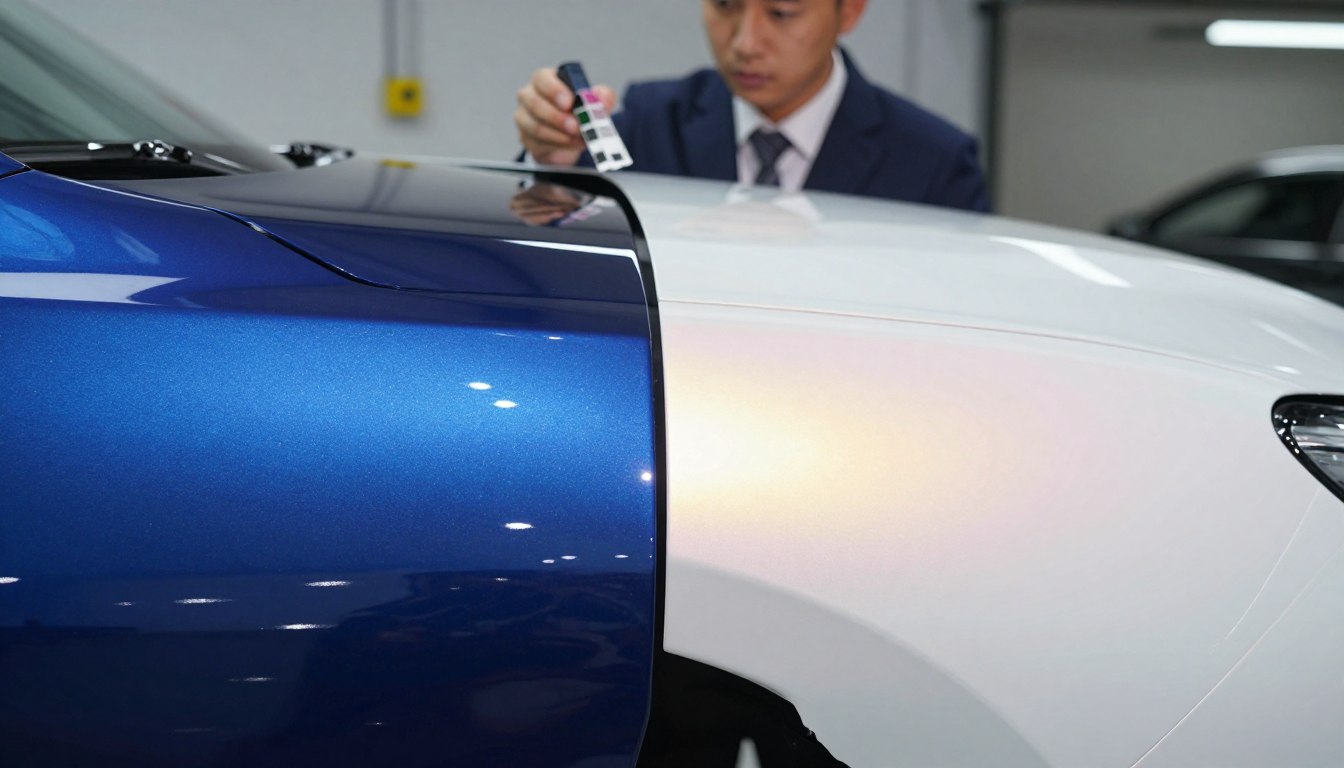
You expect a repair to vanish. But when tiny reflective flakes interact with light, even a careful fix can stand out. Miracle Body and Paint Collision Center uses advanced tech to read factory codes, flake density, and particle orientation so your vehicle gets a seamless finish.
Modern finishes include a primer, a base coat with reflective particles, and a clear coat. A slight change in spray angle or flake concentration can make a panel look different under direct sun.
Our technicians follow a precise process to replicate the original formula and account for batch variation and years of UV fade. That attention to step-by-step technique helps the repaired panel blend across adjacent panels and restores factory-grade appearance.
Key Takeaways
- Microscopic flakes create the shimmer that makes repairs tricky.
- Replicating factory code, flake density, and particle orientation is essential.
- Even small deviations in spray angle or concentration reveal flaws in sunlight.
- Technicians must adjust for batch variation and UV fade for an invisible repair.
- Advanced technology and precise steps deliver a seamless vehicle finish.
The Science Behind Paint Matching Metallic Colors
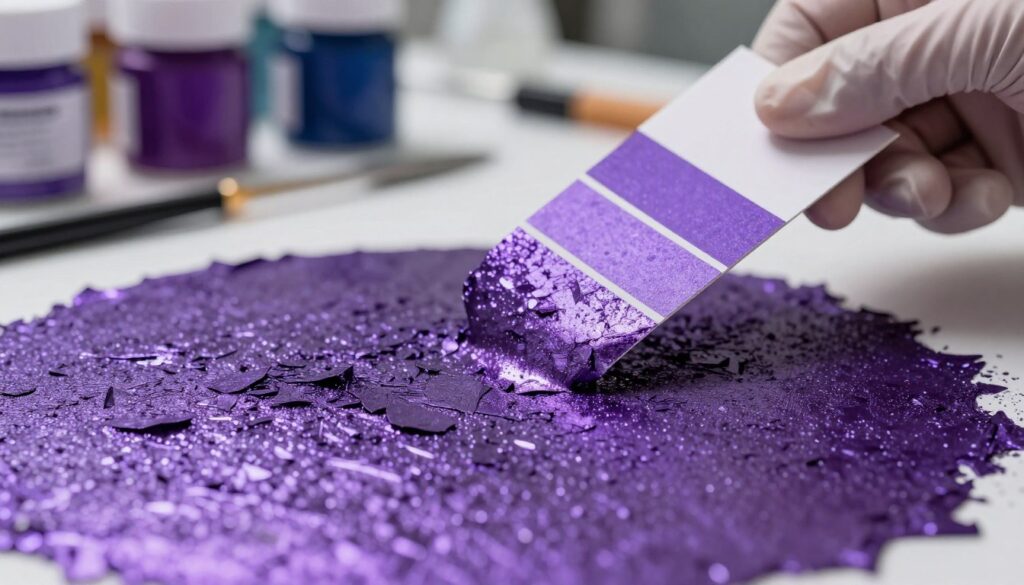
How light meets microscopic flakes decides whether a panel blends or betrays a repair. The shimmer you notice comes from aluminum or mica particles that throw light differently at various viewing angles. A correct formula alone won’t guarantee a seamless finish.
Measuring reflectance matters. Technicians use a spectrophotometer to capture data at multiple angles and build a digital profile of your vehicle’s finish. The code on the door jamb gives a starting formula, but it doesn’t reflect weathering or batch variation.
How flakes lie depends on spray technique. Spray gun distance, air pressure, and pass speed change particle orientation. That affects depth and the way the clear coat interacts with light.
- Goniochromism and metamerism mean a match can look right under shop lamps and wrong in sunlight.
- We test on spray-out cards and adjust the formula and process before working on your panels.
Why Metallic Finishes Present Unique Repair Challenges
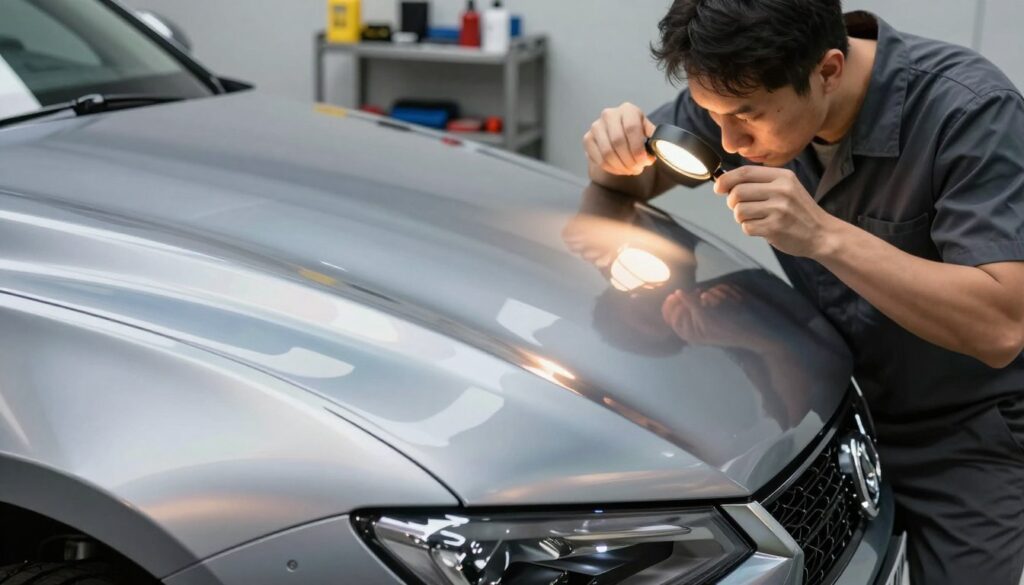
You notice a repair when flakes and depth look different across panels. Tri-coat systems add a ground coat, a translucent mid-coat, and a final clear coat. That layered build means one wrong step will reveal itself under direct light.
Factory codes give a starting formula, but reformulated codes and natural oxidation change how pigment and flakes behave. Temperature and humidity in a climate-controlled shop affect solvent evaporation and how flakes settle during spray.
- Panel-to-panel variation often exists from the factory, so a repair must blend into adjacent panels to avoid a hard line.
- When original paint codes are discontinued, a technician mixes and tests manual adjustments until the visual match reads correctly at different viewing angles.
- Precise spray technique — gun distance, air pressure, and pass speed — controls flake orientation and final sheen.
- Blending and careful process control are essential so your vehicle shows a seamless finish rather than a patch.
Professional Techniques for Achieving an Invisible Blend
Science and craft combine to hide a repair so well you won’t spot it at normal viewing angles. The right tools and steady hands turn measurements into a seamless finish.
Spectrophotometer Scanning
A spectrophotometer provides the scientific foundation by reading light reflectance directly from your vehicle’s surface. That digital profile guides the color formula and reveals how flakes and pigment behave at different angles.
Custom Formula Mixing
Technicians adjust tint and flake concentration to match the vehicle’s age and wear. I-CAR trained staff perform test sprays until the formula and flake orientation mirror the original factory code and finish.
The Art of Panel Blending
Panel blending fades new material into adjacent panels so the eye sees continuity, not a patch. Professional spray technique controls air pressure and pass speed to set flake direction before the final clear coat seals the result.
| Technique | Purpose | Tools | Outcome |
|---|---|---|---|
| Spectrophotometer scan | Capture reflectance profile | High-end scanner | Accurate formula base |
| Custom mixing | Adjust tint and flake load | Blend booth, scales | Visual match across panels |
| Panel blending | Smooth transition | Spray gun, test cards | Invisible repair at normal viewing angles |
Essential Factors for Selecting a Quality Collision Center
Choosing the right collision center starts with checking the tools and training behind every repair. You want a shop that combines modern equipment with documented certification so your vehicle gets a true factory-grade finish.
Look for I-CAR Gold Class certification. That status shows technicians train in current techniques for complex repairs, including flakes, spray technique, and clear coat application.
Verify on-site spectrophotometer use and climate-controlled spray booths. These items control light response, flake orientation, and humidity during the process so adjacent panels blend correctly.
- A written warranty protects you from peeling, fading, or color mismatch after the repair.
- Review the shop’s portfolio of previous finishes and pearl work to assess real results.
- Ask about the technician’s experience with paint code replication and panel blending.
| Feature | Why it matters | What to ask | Expected outcome |
|---|---|---|---|
| I-CAR Gold Class | Validated training | Certification proof | Skilled technician repairs |
| Spectrophotometer | Accurate formula read | On-site scanning | Better color and flake match |
| Climate booth | Controlled environment | Temperature/humidity specs | Consistent flake orientation |
| Warranty & Portfolio | Trust and proof | Written warranty, photos | Peace of mind and visible results |
Miracle Body and Paint Collision Center has two San Antonio locations ready to serve you. Call North West (Leon Valley) at (210) 680-1987, 6217 Grissom Rd., San Antonio, TX 78238, or North East at (210) 858-3630, 4650 Walzem Rd, San Antonio, TX 78218.
Conclusion: Trusting the Experts for Your Vehicle Restoration
Choose experts who combine measurement tools and steady hands to deliver an invisible repair. We use precise scans and test sprays to get the right paint and matching profile for your vehicle.
Advanced formulas control flake, coat thickness, and how light reacts across panels. That careful approach makes finishes read correctly and keeps color shifts from showing up under sun.
Achieving a true match depends on process and a skilled technician. Our team blends formula, spray technique, and panel blending to restore a factory-grade finish.
Don’t settle for a visible repair. Visit Miracle Body and Paint Collision Center at 6217 Grissom Rd., Leon Valley or 4650 Walzem Rd., North East San Antonio. Call North West (Leon Valley) at (210) 680-1987 or North East at (210) 858-3630 to schedule service.

